
Himalayan Salt Quality: From Appearance to B2B Supply
Himalayan Salt is recognised around the world for its distinctive pink colour. But for commercial buyers, colour is only the beginning of the quality conversation.
For importers, distributors, wholesalers, food businesses and private-label partners, the more important questions are:
What defines Himalayan Salt quality? How should it be specified? And how can a supplier maintain consistency from one shipment to the next?
At Organic Himalayan Food, we believe that understanding these factors is essential for building reliable B2B supply relationships.
From grain size and purity to processing, specifications and consistency, every stage contributes to the quality of the finished product.
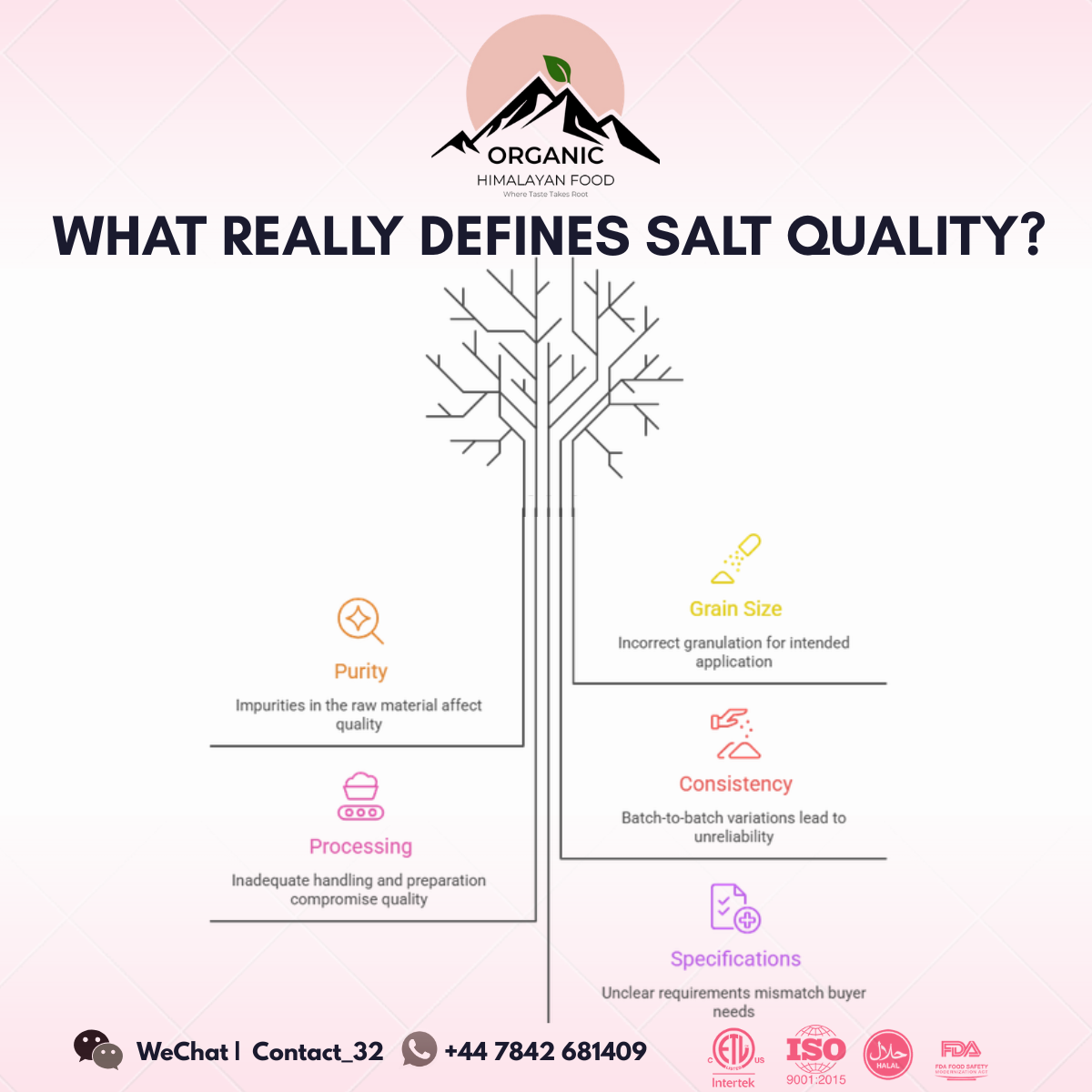
Beyond the Pink Colour: What Defines Himalayan Salt Quality?
The distinctive colour of Himalayan Salt is one of its most recognisable characteristics, but appearance alone does not provide a complete picture of commercial quality.
For B2B buyers, several factors deserve attention.
1. Grain Size
Different applications require different grain sizes.
Fine, medium, coarse and larger salt pieces can serve different culinary, food-service, processing or product-development requirements.
A supplier should therefore be able to provide the appropriate specification for the intended application rather than treating all Himalayan Salt as the same product.
2. Purity and Cleanliness
The quality of the raw material and how it is handled throughout the supply chain are important considerations.
For commercial buyers, the focus should extend beyond appearance to the product’s defined characteristics, processing controls and applicable food-safety requirements.
3. Consistency
Consistency is particularly important in B2B supply.
A buyer may require the same product specification across multiple orders. Variations in grain size, appearance or other characteristics can create challenges for packaging, processing, product development and downstream operations.
4. Processing and Preparation
Himalayan Salt can undergo different forms of processing depending on the required product.
Crushing, grading, drying and preparation can all play a role in producing a product suitable for a particular specification or application.
5. Clear Product Specifications
Commercial buyers need more than a product name.
They need clarity about what they are sourcing — including the relevant grade, grain size, physical characteristics, processing requirements and other agreed specifications.
This is where a professional Himalayan Salt supplier becomes an important part of the B2B supply chain.
At Organic Himalayan Food, we approach Himalayan Salt as a specification-driven product, with a focus on the characteristics that matter to international B2B buyers.
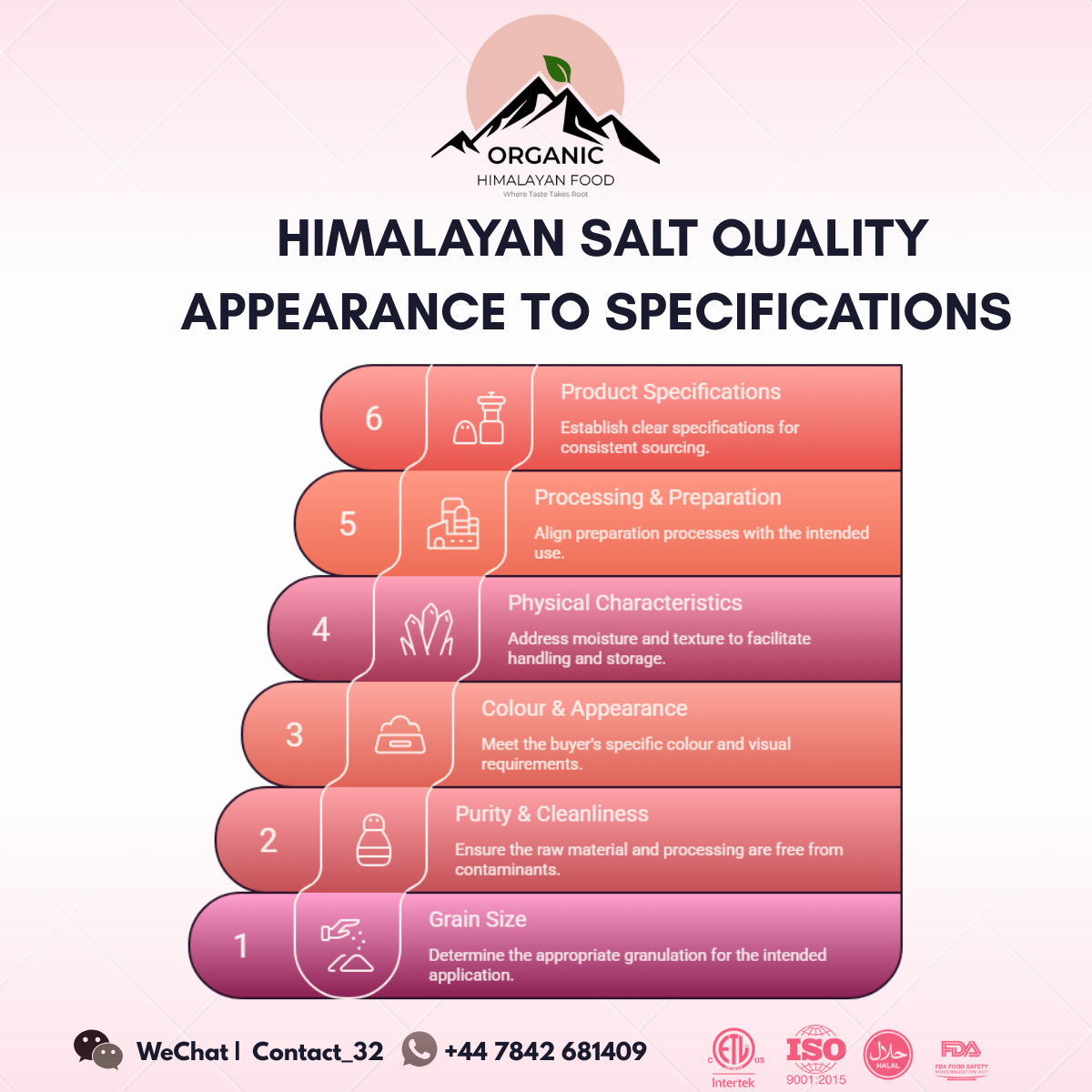
Understanding Himalayan Salt Quality: From Appearance to Specifications
Once we move beyond appearance, the next question is:
How should commercial buyers assess Himalayan Salt quality?
There is no single specification that defines every Himalayan Salt product. Requirements can vary according to the intended use, buyer requirements and market.
For this reason, B2B sourcing should begin with clearly defined product specifications.
These may include:
Grain size or granulation
Colour and appearance
Purity and cleanliness requirements
Processing and preparation
Moisture and other relevant physical characteristics
Packaging requirements
Intended application
Batch and traceability information
Any applicable food-safety and regulatory requirements
Clear specifications help both sides understand what is being supplied and create a stronger basis for repeat orders.
Quality Is More Than Appearance
For a UK buyer, product quality also needs to be considered within the wider food supply chain.
UK government guidance states that imports of salt from third countries must meet the same or equivalent food hygiene and compositional standards and procedures as food produced in Great Britain. The guidance also covers areas including additives, labelling, packaging, food hygiene, pesticides and contaminants.
Food information placed on packaging must also be clear, easy to understand and not misleading, with mandatory information required for applicable prepacked foods.
This means that for international B2B supply, quality is not simply about how the salt looks.
It is about whether the product, specification, processing, documentation and supply process work together.
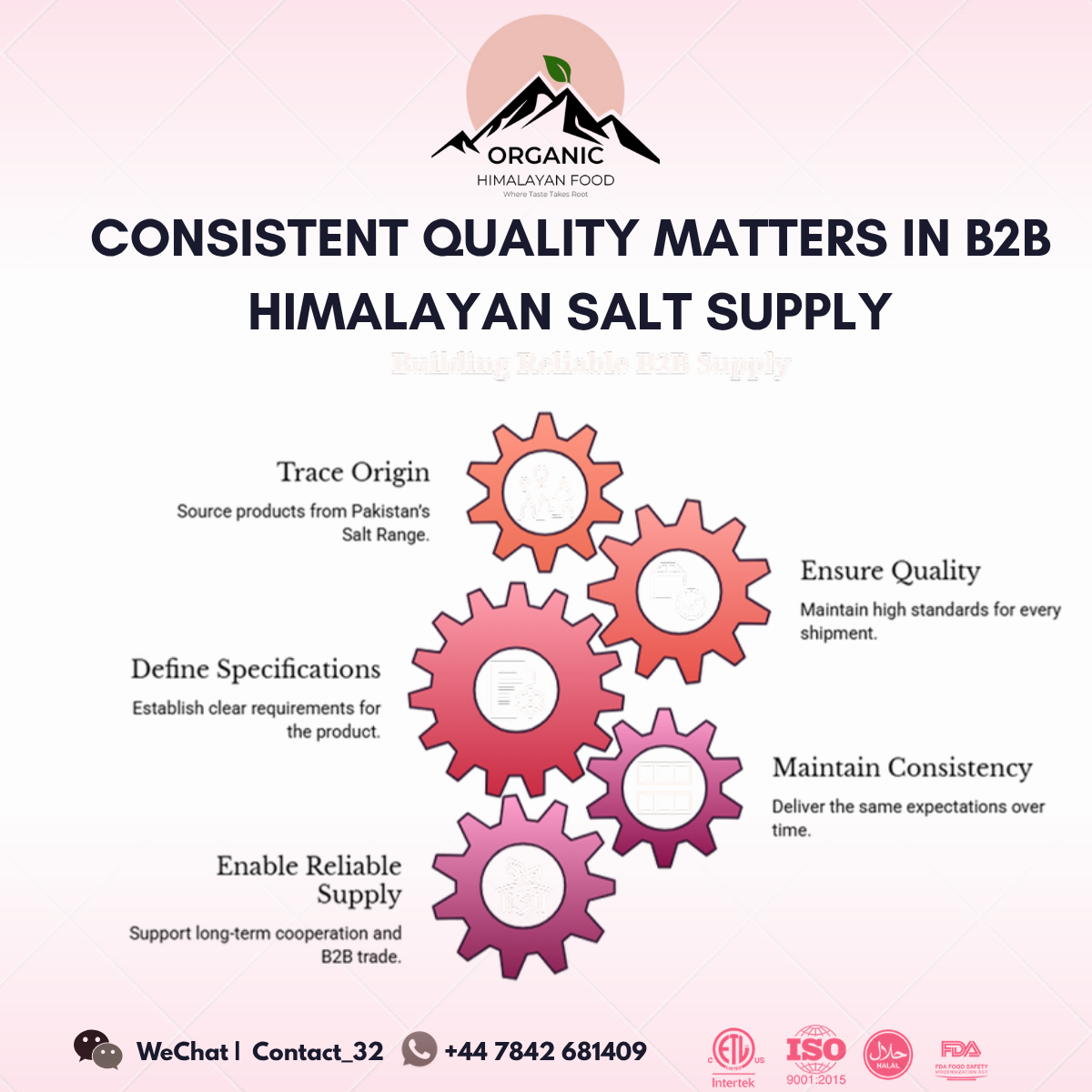
Why Consistent Quality Matters in B2B Supply
Imagine receiving a Himalayan Salt shipment that meets your requirements.
The order is successful.
But what happens with the next shipment?
This is where the difference between a product supplier and a reliable B2B supply partner becomes important.
For importers, distributors, wholesalers, food businesses and private-label partners, consistency can support:
More predictable production and processing
Consistent product presentation
Smoother packaging operations
Better planning for repeat orders
Greater confidence when placing future orders
Stronger long-term supplier relationships
A buyer does not simply need the right product once.
They need confidence that agreed requirements can be maintained over time.
Consistency Builds Buyer Confidence
In international trade, repeat business depends heavily on reliability.
If product characteristics change significantly between shipments, buyers may face additional challenges in their own operations.
That is why an effective B2B supply relationship should connect:
Origin → Quality → Specifications → Consistency → Reliable Supply
At Organic Himalayan Food, this approach is central to how we position Himalayan Salt for international B2B markets.
Our focus is not simply on the distinctive pink appearance of Himalayan Salt, but on the wider qualities that matter to professional buyers — from sourcing and processing to specifications and dependable supply.
Traceability: An Important Part of the Supply Chain
Quality also needs to be supported by supply-chain visibility.
UK government guidance advises food businesses to use reputable suppliers and maintain traceability records. These records can include supplier and customer details, product type and quantity, and transaction and delivery dates.
For B2B buyers, traceability can therefore form an important part of supplier evaluation.
A transparent supply chain can help buyers understand:
Where did the product come from?
What was supplied?
When was it supplied?
Who supplied it?
What specification was agreed?
For Himalayan Salt sourced from Pakistan, origin and supply-chain transparency can help provide greater clarity around the product’s journey from source to international market.
What Should B2B Buyers Look for in a Himalayan Salt Supplier?
When evaluating a Himalayan Salt supplier in the UK or for supply into the UK market, buyers can consider several practical factors.
1. Consistent Sourcing
The supplier should have a clear understanding of product origin and sourcing.
2. Defined Specifications
Product requirements should be clearly communicated and agreed before supply.
3. Controlled Processing
Processing and preparation should be appropriate for the intended product and application.
4. Quality and Food-Safety Awareness
The supplier should understand the requirements relevant to the destination market and intended use.
5. Traceability and Documentation
Clear records and supporting documentation can contribute to supply-chain transparency.
6. Supply Capability
A supplier should be able to support the buyer beyond a single shipment and work towards consistent repeat supply.
7. Long-Term B2B Approach
Reliable international trade is built through communication, consistency and cooperation — not simply one successful transaction.
Organic Himalayan Food: From Pakistan to International B2B Markets
At Organic Himalayan Food, we see Himalayan Salt as more than a product recognised by its pink colour.
It represents a supply journey that begins with its origin in Pakistan and continues through sourcing, processing, quality considerations, specifications, packaging and international B2B supply.
We work with importers, distributors, wholesalers, food businesses and private-label partners looking for Himalayan Salt supply from Pakistan for international markets.
Our approach is built around four key principles:
Quality.
Consistency.
Transparency.
Reliable Supply.
For buyers, this means looking beyond the appearance of Himalayan Salt and asking the questions that matter throughout the supply chain.
From Pink Colour to Proven Quality
The story of Himalayan Salt does not end with its colour.
The pink appearance may attract attention, but commercial quality goes deeper.
Grain size defines suitability.
Purity supports quality expectations.
Processing shapes the finished product.
Specifications create clarity.
Consistency builds confidence.
Reliable supply builds partnerships.
For B2B buyers, understanding these factors can make the difference between simply sourcing Himalayan Salt and developing a dependable long-term supply relationship.
At Organic Himalayan Food, our goal is to connect the natural origin of Himalayan Salt in Pakistan with the quality, consistency and supply expectations of international B2B markets.
Because quality is not defined by colour alone.
It is defined by what stands behind the product.